
How to Choose the Right Cone Crusher Model: A Complete Selection Guide
A cone crusher is one of the most critical pieces of equipment in any crushing and screening circuit. It is the workhorse of secondary and tertiary crushing — responsible for reducing medium-hard to hard rock into precisely sized aggregates for construction, mining, and industrial applications.
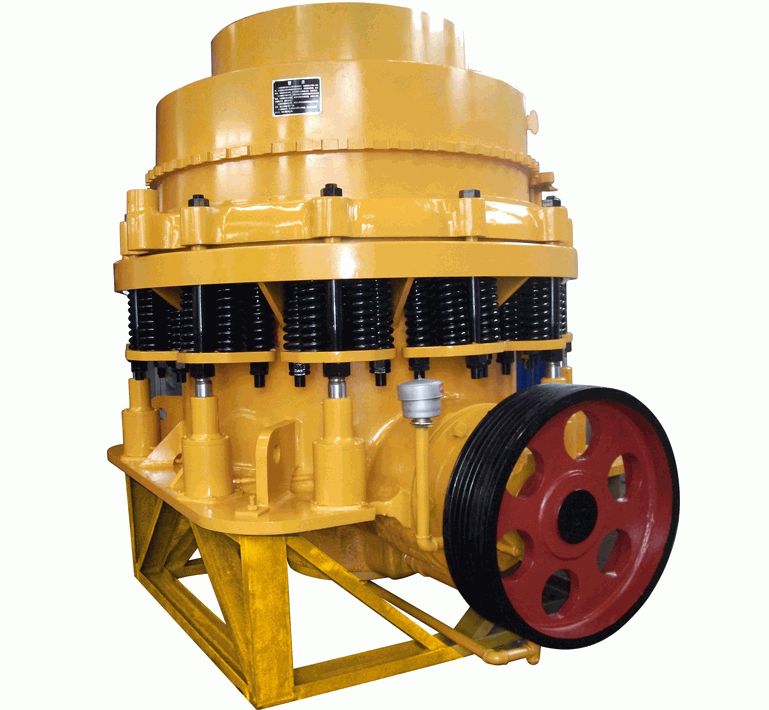
But choosing the right cone crusher model is not straightforward. The market offers dozens of models across multiple brands, each with different cavity types, eccentric throws, motor powers, and throughput ratings. Selecting the wrong model can result in chronic production bottlenecks, excessive wear costs, poor product shape, or an oversized machine that wastes capital and energy.
This guide explains the key factors you need to consider when selecting a cone crusher model — from understanding crusher types and cavity designs to matching the crusher to your feed material, capacity requirements, and product specifications.
1. Understand the Two Main Types of Cone Crushers
Before selecting a specific model, you need to determine which type of cone crusher is right for your application. The two main categories are:
1.1 Standard Cone Crusher (Secondary Crushing)
- Designed for medium to large feed sizes (typically 100–300 mm)
- Used as a secondary crusher after a jaw crusher or gyratory crusher
- Produces a medium-sized product (typically 13–51 mm depending on CSS)
- Higher throughput capacity than short-head type at the same size
- Suitable for crushing ratio of 3:1 to 6:1
Typical applications: Granite, basalt, diabase, river pebble, iron ore, copper ore — secondary crushing stage in aggregate production and mining circuits.
1.2 Short-Head Cone Crusher (Tertiary Crushing)
- Designed for smaller feed sizes (typically 50–130 mm)
- Used as a tertiary or fine crusher after a standard cone crusher
- Produces a finer product (typically 5–25 mm depending on CSS)
- Longer parallel crushing zone produces better product shape and finer gradation
- Suitable for crushing ratio of 4:1 to 8:1
Typical applications: Final-stage crushing for manufactured sand, fine aggregates, and mineral processing circuits where a well-shaped, fine product is required.
1.3 Standard vs. Short-Head: Quick Comparison
Key point: Some modern cone crusher designs (such as multi-cylinder hydraulic cone crushers) use interchangeable cavity liners to switch between standard and short-head configurations on the same base machine — providing flexibility for changing production requirements.
2. Choose Between Single-Cylinder and Multi-Cylinder Hydraulic Cone Crushers
Modern hydraulic cone crushers are divided into two main structural designs, each with distinct advantages:
2.1 Single-Cylinder Hydraulic Cone Crusher
How it works: A single hydraulic cylinder mounted under the main shaft supports the crushing head and provides both overload protection and CSS (closed side setting) adjustment.
2.2 Multi-Cylinder Hydraulic Cone Crusher
How it works: Multiple hydraulic cylinders (typically 4–8) are arranged around the upper frame, providing uniform crushing force and precise CSS control. A fixed-axis design with a rotating mantle is common in this type.
2.3 Which Type Should You Choose?
3. Match the Crusher to Your Feed Material
The characteristics of your feed material have a direct impact on model selection. Consider the following:
3.1 Rock Hardness and Abrasiveness
Abrasive materials (high quartz content, silica-rich rock) cause accelerated liner wear. For these applications, specify:
- Higher manganese content in liners (Mn18Cr2 or Mn22Cr2 instead of standard Mn13)
- Short-head cavity with longer parallel zone (reduces peak crushing forces)
- Consider a slightly oversized crusher operating at reduced CSS — this lowers the force per unit of feed and extends liner life
3.2 Feed Size Distribution
Your cone crusher must accept the maximum lump size from the upstream crusher (typically a jaw crusher). Check that:
- The feed opening (inlet width) of the cone crusher is at least 1.2–1.5× the maximum lump size from the jaw crusher
- The throughput rating matches the output of the upstream crusher at the required product size
Common mismatch problem: Selecting a cone crusher with a feed opening that is too small for the jaw crusher's output. This causes bridging, uneven feed distribution, and reduced throughput.
3.3 Feed Moisture and Clay Content
If your feed material contains significant moisture (> 5%) or clay/soil fines:
- The material may stick to the crushing chamber, causing build-up and throughput loss
- Ensure the crusher has adequate feed distribution to prevent segregation of fines to one side
- Pre-screening (scalping) the feed to remove soil and fines before the cone crusher is strongly recommended
4. Determine Your Capacity and Product Requirements
4.1 Required Throughput
Define your target throughput in tons per hour (t/h) at the required product size. This is the single most important number for model selection.
Important: Always specify throughput at the required product size — not at a coarse setting. A crusher may produce 500 t/h at 50 mm CSS but only 280 t/h at 19 mm CSS.
4.2 Required Product Size and Gradation
What is the maximum product size you need? What is the required gradation (particle size distribution)?
- Larger product size (25–51 mm): Standard cavity, wider CSS — higher throughput, coarser product
- Finer product size (5–19 mm): Short-head cavity, narrower CSS — lower throughput, finer product
- Manufactured sand (0–5 mm): Short-head at very tight CSS, or a vertical shaft impact (VSI) crusher may be needed as a supplementary shaping stage
4.3 Product Shape Requirements
Many aggregate specifications (e.g., for asphalt or concrete) require well-shaped particles — cubical rather than elongated or flaky. Factors that improve product shape:
- Longer parallel crushing zone (short-head cavity)
- Higher crushing ratio (forces particles to break along natural fracture planes)
- Proper feed distribution — choke feeding (keeping the crushing chamber full) produces better shape than partially fed operation
- Multi-cylinder design generally produces better shape than single-cylinder at the same CSS
5. Select the Right Cavity (Liner Profile)
The cavity liner profile is the most important factor determining your crusher's performance at a given setting. Most cone crusher manufacturers offer multiple cavity options for the same base crusher model.
Typical Cavity Options
How to choose:
- If you need maximum throughput at a coarser product size → Coarse or Extra Coarse cavity
- If you need a fine, well-shaped product → Fine or Extra Fine cavity (short-head type)
- If your feed is variable and you may need to adjust → Medium cavity (most versatile, but not optimal for extremes)
Tip: Always request the manufacturer's crushing capacity curves for each cavity option. These charts show throughput vs. CSS for each cavity, plotted for your specific feed material and target product size. Do not rely on a single number in a brochure.
6. Consider Key Machine Specifications
When comparing specific models, focus on these critical specifications:
7. Match the Cone Crusher to Your Plant Configuration
The cone crusher does not work in isolation — it must be properly integrated with the upstream and downstream equipment in your crushing circuit.
7.1 Upstream Equipment
The cone crusher's feed opening and throughput must match the jaw crusher's output. A common engineering error is pairing a large jaw with a small cone, creating a bottleneck.
7.2 Screening and Closed-Circuit Operation
Most cone crushers operate in a closed circuit with a vibrating screen:
- Screen oversize (+) returns to the cone crusher for recrushing
- Screen undersize (-) goes to the next stage (stockpile or sand making)
This arrangement ensures that the cone crusher consistently receives properly sized feed and that the product meets specification.
Ensure your screen capacity matches the crusher throughput — an undersized screen becomes a bottleneck that forces the crusher to operate at reduced throughput.
8. Common Models and Size Classes
The following table provides a general guide to common cone crusher size classes and their typical applications. Note that specific model numbers vary by manufacturer.
For multi-cylinder hydraulic cone crushers, equivalent size classes are typically designated by mantle diameter or model series number. Always compare specifications across manufacturers using the feed opening, CSS range, and throughput at target product size — not just the model number.
9. Evaluate Total Cost — Not Just Purchase Price
The purchase price of the cone crusher is only one component of your total operating cost. Over a 10-year ownership period, the following costs typically dominate:
Key takeaway: A crusher with a lower purchase price but shorter liner life, higher energy consumption, or more frequent breakdowns will almost certainly cost you more over its lifetime.
Ask your supplier:
- What is the expected liner life for your specific rock type and throughput?
- What is the specific energy consumption (kWh/ton) at your target product size?
- What preventive maintenance schedule is recommended, and what is the typical availability factor?
10. Checklist for Cone Crusher Model Selection
Why Choose Henan Hongke Machinery?
Henan Hongke Heavy Machinery Co., Ltd., based in Henan Province, China, manufactures a complete range of cone crushers — including single-cylinder hydraulic, multi-cylinder hydraulic, and spring cone crushers — for mining, quarrying, and aggregate production applications.
What we offer:
- Full model range — from 2 ft to 7 ft equivalent, covering capacities from 20 t/h to 1,200+ t/h
- Multiple cavity options — standard, short-head, and interchangeable liner profiles for each model
- Application-specific liner materials — Mn13, Mn18Cr2, Mn22Cr2, and custom alloy options for abrasive materials
- Engineering support — our team helps you select the right model, cavity, and liner for your specific material and production requirements
- Complete crushing circuit design — we can supply jaw crushers, cone crushers, vibrating screens, and conveyors as an integrated package
- Global supply — manufacturing in China, serving clients worldwide with shipping, installation supervision, and after-sales support